
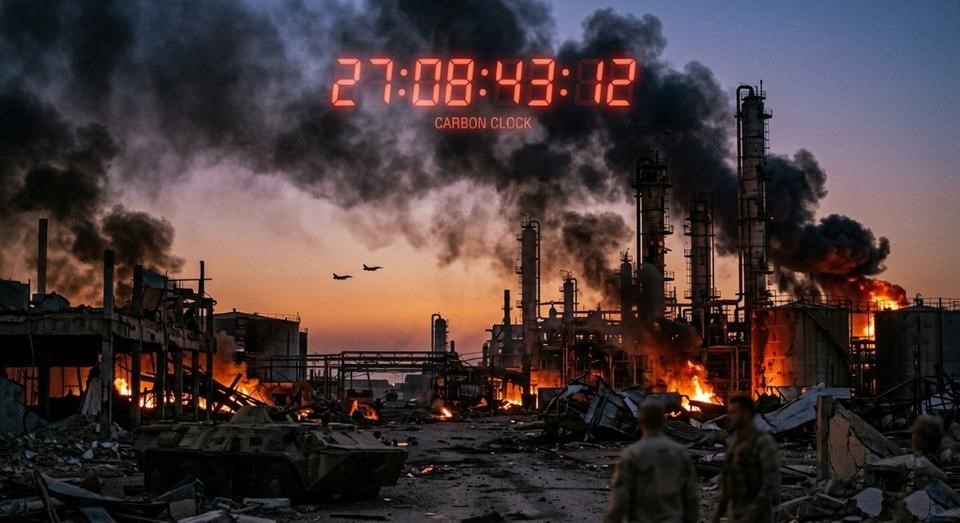
When the United States and Israel launched coordinated strikes against Iran on 28 February 2026, the world’s attention turned to the geopolitical fallout, energy markets, and humanitarian impact. What received far less attention was the carbon cost.
A new analysis published by researchers from Queen Mary University of London (QMUL), Lancaster University, and the Climate and Community Institute (CCI) has attempted to put a number on it. The findings are extraordinary, and they raise a question the ESG (Environmental, Social and Governance) community cannot afford to ignore: can we claim to be managing the climate crisis while ignoring the emissions of war?
“Emissions from armed conflict remain largely invisible in global climate policy. Without accounting for them, we are managing the climate crisis with a fundamentally incomplete ledger.” — Dr Benjamin Neimark, Queen Mary University of London
Source: https://www.qmul.ac.uk/media/news/2026/humanities-and-social-sciences/hss/war-in-iran-has-alreadyproduced-emissions-equivalent-to-a-year-of-icelands-carbon-output.html
The Numbers: What the First Two Weeks Tell Us
According to the CCI analysis published in March 2026, the first 14 days of the conflict from 28 February to 14 March 2026 generated over 5 million tonnes of carbon dioxide equivalent (CO₂e) in greenhouse gas (GHG) emissions. To put that in perspective: it exceeds Iceland’s entire annual carbon output, and it is more than 84 of the lowest-emitting countries emit in a full year.
The researchers are clear that this is a preliminary estimate, not peer-reviewed, and based on established methodologies previously used to assess emissions from the conflicts in Gaza and Ukraine. The figures will almost certainly rise as the conflict continues.
Where Did the Emissions Come From?
The breakdown is instructive, and the biggest source will surprise most people. It is not the fighter jets. It is not the missiles. It is the buildings.
According to Live Science’s coverage of the CCI report, the destruction of homes, schools, hospitals, and commercial buildings accounted for 2.4 million tonnes of CO₂e, the largest single source. When a building is bombed, the concrete, steel, and glass that embodied decades of carbon-intensive manufacturing are released into the atmosphere all at once. Data from the Iranian Red Crescent Society recorded over 16,000 residential buildings, 77 medical centres, and 69 schools damaged or destroyed in the first two weeks alone.
The second-largest source was burning and destroyed oil infrastructure. Strikes on fuel storage depots near Tehran triggered fires that blanketed the city in black smoke, producing toxic rain and releasing approximately 1.88 million tonnes of CO₂e.
Military fuel consumption from fighter jets flying from as far away as the United Kingdom, naval vessels, and support operations contributed around 529,000 tonnes. Weapons, missiles, and drones accounted for the remainder.
The Strait of Hormuz: Where Energy and Climate Risk Collide
Beyond the direct emissions of the conflict itself, the closure of the Strait of Hormuz through which roughly 20–25% of global oil supply passes is already sending ripples through energy markets worldwide. As Earth.org reports, countries like Pakistan and Bangladesh, which source the majority of their liquefied natural gas (LNG) through the Strait, are particularly exposed.
When LNG becomes scarce or too expensive, countries may pivot to coal as an alternative locking in emissions from fossil fuel infrastructure for years to come. This is the longer-term climate consequence of the conflict: not just the direct carbon cost of the bombs, but the structural shift it may force in how the world’s most vulnerable economies power themselves.
A detailed geopolitical and climate analysis from the Institute for Foreign Affairs (IFA) - War, Carbon, and Chokepoints frames this as the return of ‘fossil-security logic’: when conflict threatens energy flows, governments prioritise supply over climate commitments.
The ESG Accountability Gap: Why War Emissions Are Not Counted
Here is the uncomfortable truth: military emissions are explicitly excluded from the Paris Agreement’s national reporting frameworks. Countries are not required to disclose the GHG emissions of their armed forces, and most do not. The Conflict and Environment Observatory (CEOBS), a specialist research organisation, has documented this gap extensively, describing it as the ‘military emissions gap.’
For context: according to research by Brown University’s Costs of War project, if the US military were a country, it would rank among the world’s significant polluters, yet its emissions do not appear in US national GHG inventories. The IFA’s analysis notes that this structural omission allows war to remain peripheral in climate policy even as the direct and long-tail carbon impacts of conflict are substantial.
This is not a niche academic concern. It is a material ESG risk. If the global carbon budget is being depleted faster than climate models account for because conflict emissions are not included, then every decarbonisation target and net-zero commitment in the world is built on an incomplete foundation.
What This Means for ESG Investors, Corporates, and Policymakers
The ESG community tends to frame climate risk in terms of physical risk (floods, droughts, wildfires) and transition risk (policy change, stranded assets). The Iran conflict introduces a third dimension: geopolitical climate risk. And it matters in ways that are directly relevant to investment and business strategy.
For investors: Geopolitical risk is now climate risk. Portfolio stress-testing must account for the possibility that conflict, supply chain disruption, and fossil-security responses can meaningfully alter the global emissions trajectory. A useful framework for thinking through this is the Morningstar 2026 Sustainable Investing Outlook, which highlights energy security as a growing driver of sustainable finance decisions.
For companies in Asia, Australia, and Latin America: LNG price volatility is a direct Scope 2 and Scope 3 issue. Companies that rely on gas for their operations, or whose suppliers do, may see their emissions footprint and energy costs shift significantly. Scenario analysis already required under ISSB S2 and CSRD must now include geopolitical disruption scenarios.
For policymakers: The Iran conflict has reignited the debate about energy security versus climate ambition. The United Nations Environment Programme (UNEP) issued a statement on 13 March 2026 noting the environmental damage arising from the conflict in the Middle East. As military budgets expand globally, the case for including military emissions in national reporting frameworks becomes harder to ignore.
The Reconstruction Problem: The Emissions Are Just Beginning
The CCI report notes, with grim clarity, that the emissions from the first 14 days are almost certainly the smallest part of the total climate cost. Based on patterns from previous conflicts, the emissions from rebuilding destroyed infrastructure: homes, roads, hospitals, oil facilities, and schools will dwarf the direct war emissions. Research on Gaza and Lebanon has estimated that post-conflict reconstruction can produce at least 24 times the emissions of the conflict itself.
This point is developed further in the Countercurrents analysis of the Iran war’s carbon legacy, which covers 14 countries from Cyprus to Azerbaijan affected by the conflict’s reach. The reconstruction of this region, if and when it comes, will require carbon-intensive materials and energy at scale, over many years.
A Question for the ESG Community
The Iran conflict is, in ESG terms, an inconvenient truth. It exposes the limits of a sustainability framework that is built around peacetime assumptions: that companies will gradually decarbonise their supply chains, that governments will honour their Paris Agreement commitments, and that the global carbon budget will be consumed at a predictable rate.
None of those assumptions hold when conflict is factored in.
The ESG community - investors, corporates, standard-setters, and regulators has a responsibility to name this gap, advocate for the inclusion of military emissions in global reporting frameworks and build geopolitical disruption into climate scenario analysis.
“Ignoring war as a climate variable does not make it disappear. It just makes our ledger wrong.”