
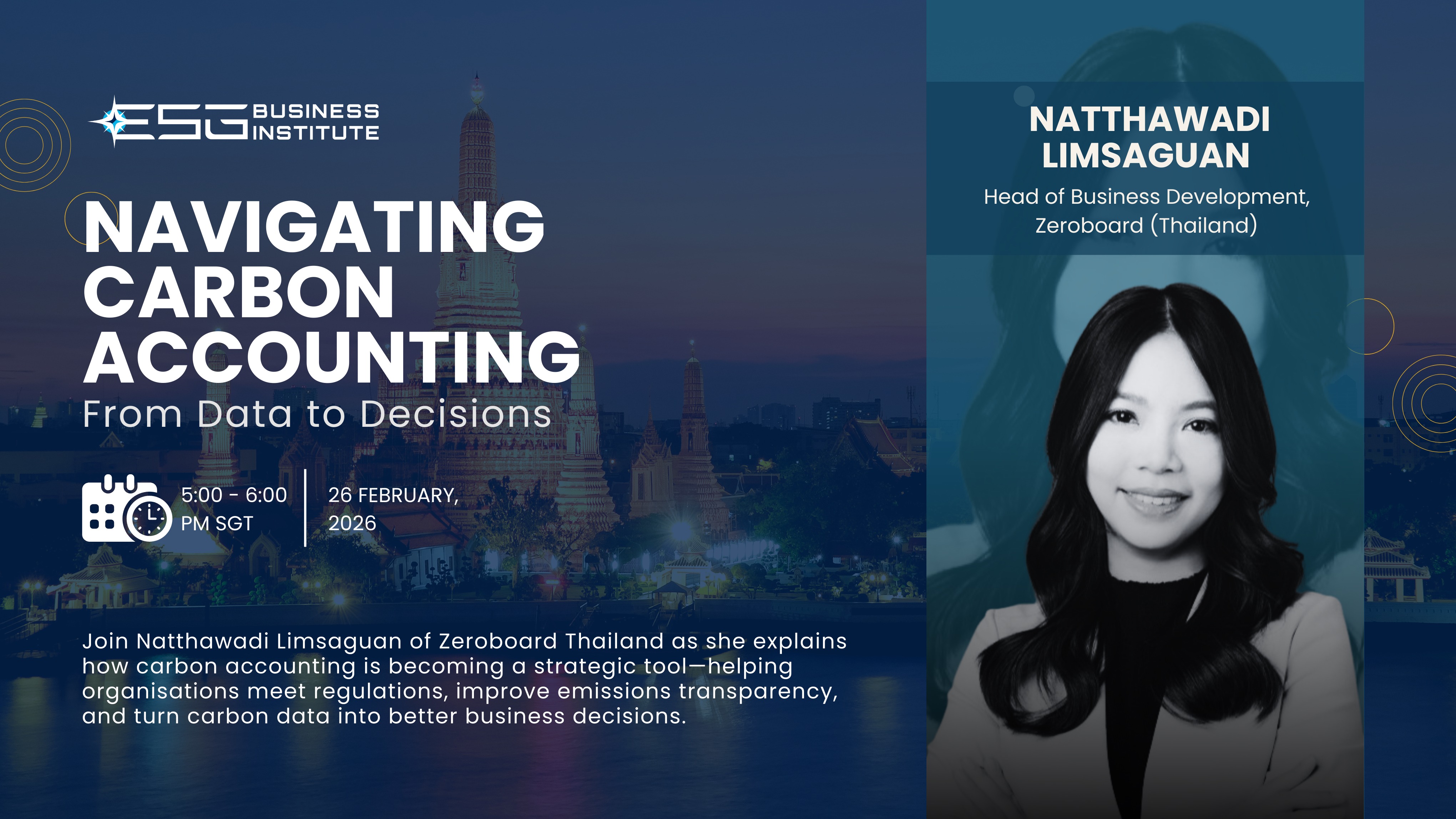
Carbon accounting is no longer just a sustainability exercise — it is rapidly becoming a core business and regulatory requirement. In the ESG Business Institute webinar “Navigating Carbon Accounting – From Data to Decisions,” experts explored how organizations can move beyond basic emissions reporting and start using carbon data to guide strategic decisions.
One of the key takeaways from the session is that carbon transparency is increasingly driven by regulation, financial institutions, and global supply chains. As governments and investors demand more reliable climate disclosures, companies must ensure their emissions data is accurate, structured, and aligned with global frameworks such as the Greenhouse Gas (GHG) Protocol and ISO 14064-1.
Under the GHG Protocol, corporate emissions are divided into three scopes. Scope 1 covers direct emissions from company operations, Scope 2 relates to purchased electricity and energy use, while Scope 3 includes emissions across the entire value chain. Scope 3 is often the most complex category, covering 15 different upstream and downstream activities, including procurement, logistics, business travel, and product use.
The webinar highlighted that Scope 3 emissions are becoming a critical focus area, especially as investors and financial institutions begin assessing the full carbon footprint of their portfolios.
A practical challenge discussed during the session is how companies actually manage carbon data across large organizations. Many firms still rely on spreadsheets for emissions calculations. However, this approach becomes inefficient as operations expand. For instance, if a company operates more than 10 subsidiaries or facilities, manually collecting and verifying emissions data becomes extremely difficult and prone to inconsistencies.
This is where digital carbon accounting platforms are gaining traction. Some solutions now support over 15,000 companies worldwide, helping organizations automate emissions calculations, integrate operational data through APIs or enterprise systems, and generate standardized reports aligned with global frameworks.
Beyond technical implementation, the webinar also highlighted major policy developments shaping the future of carbon accounting.
For example, Thailand has strengthened its climate ambition by moving its net-zero emissions target from 2065 to 2050. This shift signals that stronger climate policies are likely ahead, including a potential Climate Change Act, carbon taxation, and emissions trading mechanisms.
Another key development is the transition toward mandatory climate disclosure. Under Thailand’s roadmap, SET50 companies are expected to begin climate-related reporting aligned with IFRS sustainability standards by 2027, with requirements expanding to SET100 companies and eventually all listed firms by 2030. This reflects a broader global trend as more jurisdictions adopt disclosure frameworks aligned with the ISSB standards.
International trade is also driving carbon transparency. The European Union’s Carbon Border Adjustment Mechanism (CBAM) requires exporters in carbon-intensive sectors to report verified emissions associated with their products. This means companies that supply goods to the EU must now ensure their carbon data is credible and verifiable.
Another interesting point discussed during the webinar is the growing role of financial institutions in driving carbon data demand. Banks and investors must report the emissions associated with their portfolios, particularly under Scope 3 Category 15, which covers financed emissions. As a result, financial institutions are increasingly asking clients to disclose their carbon footprints.
This creates a ripple effect across the economy: investors request data from banks, banks request data from companies, and companies request emissions data from their suppliers. Carbon accounting is therefore expanding far beyond large corporations to include entire value chains.
The webinar ultimately emphasized that carbon accounting should not be viewed purely as a compliance task. Organizations that effectively manage emissions data can gain significant strategic advantages, including improved operational efficiency, stronger supply chain partnerships, and better access to sustainable finance.
For ESG professionals, the discussion offers valuable insights into how carbon accounting is evolving from simple emissions tracking into a powerful decisionmaking tool. From understanding complex Scope 3 emissions to navigating new climate disclosure requirements, the session provides a practical overview of the challenges and opportunities shaping the future of corporate carbon management.
Those looking to stay ahead of emerging regulations and carbon reporting expectations will find the full webinar recording particularly valuable, as it dives deeper into realworld implementation challenges and the tools organizations are using to turn carbon data into meaningful climate action.
Readers who would like to explore the insights further can also review the presenter’s slides from the session here: Zeroboard Slide
Want to dive deeper? Sign up as an ESG Business Institute Member to view the full recording of this webinar and gain access to more exclusive insights.