
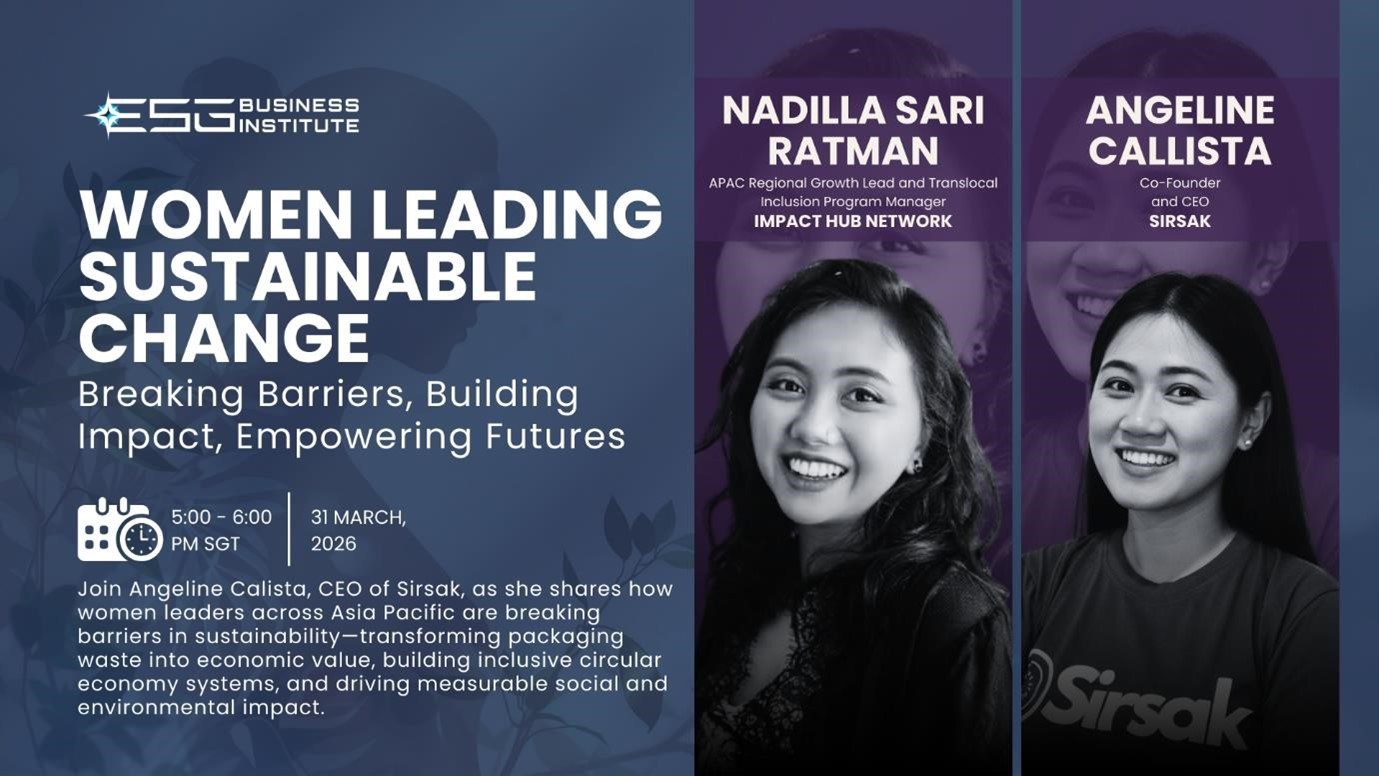
The transition
to a low-carbon economy is often framed as a technical challenge. But as
highlighted in the ESG Business Institute webinar, it is equally human—shaped
by systems that were never designed to be inclusive, and by the women working
to change them.
In this session, Angeline Calista,
Co-founder and CEO of Sirsak, and Nadilla Sari Ratman, Regional Program Manager
at Impact Hub Jakarta, shared both the realities of sustainability—and the
realities of leading as women in this space.
Breaking Into Systems Not Designed for Women
For many
women, leadership begins with resistance.
Angeline grew
up in a patriarchal environment where women were not expected to pursue
careers. Instead of accepting this, she pursued higher education, worked across
public sector and policy, and eventually built a sustainability-focused
company.
Nadilla
reflected a similar pressure:
“As a woman,
we tend to want to prove ourselves.”
This need to constantly prove capability
continues to shape women’s leadership journeys—especially in sectors already
resistant to change.
Bias Still Exists—Even in ESG
Despite
working in impact-driven spaces, gender bias remains deeply embedded.
Angeline
shared that investors questioned her commitment simply because she was getting
married—highlighting assumptions that women must choose between leadership and
personal life.
She was also
asked whether her work was backed by male family members.
At a broader level, Nadilla emphasized
that women’s voices are still often underrepresented in decision-making, with
leadership structures and funding systems still dominated by men.
Leading in Male-Dominated Industries
Sectors like
waste management and energy remain male-dominated.
Nadilla
recalled leading in rooms filled almost entirely with men, where self-doubt
became a real challenge. Yet, both speakers emphasized that women bring
critical strengths:
•
Listening and empathy
•
Multi-stakeholder thinking
•
Inclusive leadership
These qualities are essential in
sustainability, where solutions must balance environmental, social, and
economic realities.
The Reality of Sustainability Work
Beyond gender
barriers, both speakers highlighted a deeper challenge:
Sustainability
systems were never designed to work sustainably.
From waste
management gaps to cost pressures, businesses still view sustainability as a “nice-to-have” rather than a priority.
Convincing
companies to act remains difficult—especially when sustainability is seen as a
cost, not a value driver.
This makes progress slow, complex, and
often non-linear.
Driving Real Impact on the Ground
Despite these
challenges, both leaders are already creating measurable impact.
Angeline’s
company, Sirsak, is building Indonesia’s
waste traceability infrastructure, connecting collection points,
aggregators, and recyclers into a digital ecosystem that enables brands to
track and manage post-consumer waste.
Through its
packaging recovery program, Sirsak has:
•
Expanded from 0 to hundreds of collection points within a year
•
Partnered with corporate clients to recover packaging waste
• Secured
pre-seed funding (~US$600K) to scale
its system
The company is
also working to solve one of the hardest problems in sustainability— low-value plastic waste—while
supporting informal waste workers and improving transparency across the value
chain.
Meanwhile,
Nadilla leads regional programs at Impact Hub Asia Pacific, driving initiatives
that support inclusive entrepreneurship
and sustainability ecosystems.
Her work
includes:
•
Leading BEAM
(Building Entrepreneurial Access Models), supporting entrepreneurs—including
women and persons with disabilities—across multiple countries
•
Collaborating with global partners such as Cartier Women’s Initiative, Bayer
Foundation, and Bank of America to fund and scale impact-driven ventures
•
Managing programs that bridge climate action, gender inclusion, and
circular economy solutions across Asia Pacific
Together, their work demonstrates that
sustainability is not just theory—it is being built, tested, and scaled in
real-world systems.
Final Thought
Sustainability
is a long and complex journey—and for women, the path is often layered with
additional barriers.
Yet, these
leaders show that progress is already happening.
From building
national waste systems to enabling inclusive entrepreneurship across regions,
their work proves that women are not just navigating challenges—they are
reshaping industries and creating measurable impact.
“We have the
superpower… to nurture, to lead, and to keep going.”
Want to dive deeper? Sign up as
an ESG Business Institute Member to view the full recording of this webinar and
gain access to more exclusive insights.