

How the IPBES Business & Biodiversity Report and TNFD Are Reshaping Corporate Accountability in 2026
The Biodiversity Wake-Up Call
For years, biodiversity was the sustainability issue that
finance and compliance teams quietly deferred to another department. Not
anymore.
In February 2026, the Intergovernmental Science-Policy
Platform on Biodiversity and Ecosystem Services (IPBES) released its landmark Business
& Biodiversity Assessment and it rewrote the terms
of the conversation. Biodiversity loss is no longer framed as an environmental
concern. It is now officially classified as a systemic risk to the global
economy.
That language matters. “Systemic risk” is the vocabulary of
central banks and financial regulators. It is the vocabulary of boards, not
just CSR reports. And it is the vocabulary that, historically, precedes
mandatory action.
|
|
|
“Nature loss is not an environmental footnote — it is a
financial stability issue.” |
|
|
The Scale of Exposure
Before diving into frameworks and timelines, it helps to
understand why the urgency is real and why regulators are paying attention.
|
|
|
|
|
$58T |
73% |
733+ organizations
across 56 countries committed to TNFD
disclosures |
Sources:
$58T — PwC Nature Risk Report (2023) / WEF New Nature Economy Report (2020),
updated figure widely cited by WWF & IPBES; 73% — WWF Living Planet Report
2024 (ZSL Living Planet Index, tracking 34,836 populations of 5,495 species,
1970– 2020); 733+ — TNFD Adopters Registry (tnfd.global)
Put
simply: if your business depends on
stable supply chains, water, agriculture, fisheries, or raw materials, it
depends on nature.
From Voluntary to Mandatory: The Regulatory Arc
The progression here follows a familiar pattern in
sustainability regulation. First come voluntary frameworks. Then reporting
expectations harden. Then disclosure becomes mandatory. We have seen it with
climate. Nature is following the same arc, only faster.
The Kunming-Montreal Global Biodiversity Framework,
adopted in 2022, set the trajectory. Target 15 specifically calls on large
companies to assess, disclose, and reduce their biodiversity impacts. The
European Union is already embedding this into domestic regulation, with
implications for any company operating in or exporting to the EU.
Meanwhile, 2026 is shaping up to be a critical platform
year for the Science Based Targets Network (SBTN), which
validated its first corporate nature targets in early 2025. The significance:
for the first time, companies have a science-grounded methodology to set
meaningful, measurable nature commitments and not just intentions.
The Taskforce on Nature-related Financial Disclosures (TNFD) provides the reporting
architecture. With over 733 organizations already signed on across 56
countries, TNFD adoption is moving rapidly from early-adopter territory into
mainstream expectation.
|
📂 Case Study:
Kering (Luxury & Fashion) Industry:
Luxury goods / fashion What they
did: Kering has been piloting biodiversity integration into its
sourcing strategy, including ecosystem impact assessments across its leather
and cotton supply chains. The company is among the early corporate adopters
testing TNFD-aligned reporting. Outcome: Kering’s
Environmental Profit & Loss (EP&L) model now captures nature-related
costs, giving the company a financial lens on biodiversity risk that goes
beyond compliance influencing sourcing decisions and supplier engagement.
|
|
|
|
📂 Case Study:
Carrefour (Retail & FMCG) Industry:
Retail / FMCG What they
did: Carrefour has been working to integrate biodiversity
metrics into its supplier assessment frameworks, particularly for high-risk
commodities like soy and palm oil. |
|
|
|
Outcome: By
mapping which product categories carry the highest nature-related risk
upstream, Carrefour has been able to prioritise supplier engagement
and set more credible deforestation-free commitments. |
|
|
ASEAN: Caught Between Hotspot and Hub
The ASEAN region faces a particular tension in this moment.
It is home to extraordinary biodiversity: the forests of Borneo, the marine
ecosystems of the Coral Triangle, the agricultural landscapes of the Mekong
Delta while also serving as one of the world’s most critical manufacturing and
supply chain hubs.
That dual role creates both exposure and opportunity. On
one hand, ASEAN-based companies supplying to European markets are increasingly
subject to the EU’s emerging nature-related disclosure requirements. On the
other, the transition to a nature-positive economy is projected to unlock
significant new value across the region in sustainable agriculture, ecosystem
services, and green finance.
Investor pressure is also intensifying. Institutional
investors are increasingly seeking integrated climate-and-biodiversity
reporting, treating nature-related risk as material to capital allocation
decisions. For ASEAN companies seeking international capital, aligning with
TNFD is rapidly becoming a market access question, not just a values question.
|
|
|
For ASEAN companies supplying to EU
markets, TNFD alignment is becoming a market access question, not just a
values question. |
|
|
The Honest Reality: Implementation Is Hard
The frameworks are multiplying. The expectations are
rising. The hard part? Making it operational.
The Nature Positive Initiative has identified over 600
different environmental metrics currently in use across
corporate reporting. That fragmentation creates genuine confusion especially
for sustainability teams trying to figure out where to start, what to measure,
and how to ensure comparability.
A major consultation on metric harmonisation ran in early
2026, with the goal of building a more consistent, credible measurement
framework. But in the interim, companies face a real risk of disclosure
fatigue: producing reports that satisfy checklists without driving real change.
The more fundamental challenge is cultural. Biodiversity
risk needs to move from sustainability departments into procurement, finance,
and boardrooms. The gap between awareness and operational decision-making
remains wide and closing it requires more than good intentions.
What Companies Should Do Now
The compliance clock is ticking but this is also an
opportunity to get ahead of the curve. Here is a practical starting framework:
• Start with a dependency audit. Assess
your nature-related risks and dependencies using tools like ENCORE (Exploring
Natural Capital Opportunities, Risks and Exposure), which maps how business
sectors depend on and impact ecosystem services.
• Map your value chain. Identify which
parts of your value chain carry the highest biodiversity risk typically
upstream in raw material sourcing. High-risk commodities include soy, palm oil,
beef, timber, and certain minerals.
• Align with emerging frameworks. Begin
engaging with TNFD’s disclosure recommendations and explore SBTN’s corporate
nature target methodology. Even voluntary adoption now builds credibility and
prepares you for mandatory regimes ahead.
• Bring nature into the boardroom. Biodiversity
risk assessments need to inform procurement, investment, and strategic
decisions not just sustainability reports.
• Be transparent, not just optimistic. Disclose what you know and what you are working on but ensure it is backed by real data and measurable commitments. The era of narrativeonly sustainability reporting is ending.
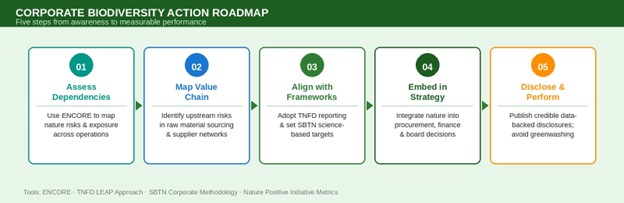
Figure
2: Corporate biodiversity action roadmap — from initial assessment to credible
performance reporting.
A Defining Moment — If Companies Act Like It
Every major regulatory shift in sustainability has had a
defining year, a moment when the direction became undeniable and the laggards
became visible. For climate, it was the years following the Paris Agreement.
For human rights due diligence, it was the wave of national legislation through
2021-2023.
2026 may be that year for nature.
The IPBES report has given policymakers and investors the
scientific mandate. TNFD and SBTN have given companies the tools. The
Kunming-Montreal Framework has given governments the political commitment. What
remains is execution.
Nature is no longer a background condition
for business. It is becoming a foreground compliance requirement.
The companies that move now building measurement
capability, integrating nature into strategy, and reporting with credibility
will be far better positioned than those waiting for mandatory deadlines to
force their hand.
Key
References & Further Reading
IPBES
Business & Biodiversity Assessment media release:
https://www.ipbes.net/bba-report/media-release
IUCN
response to IPBES report:
https://iucn.org/news/202602/ipbes-business-and-biodiversity-report-highlightscollaboration-needed
CouncilFire
— Nature-positive corporate strategy:
https://www.councilfire.org/blog/nature-positive-businessbiodiversity-integrating-nature-into-corp…
Dunya
Analytics — Why 2026 is nature’s breakthrough year: https://www.dunya-analytics.com/insights/why-2026could-be-natures-breakthrough-year-for-business
Nature
Positive Initiative — Metrics: https://www.naturepositive.org/metrics/
TNFD
Adopters Registry: https://tnfd.global/engage/tnfd-adopters/