
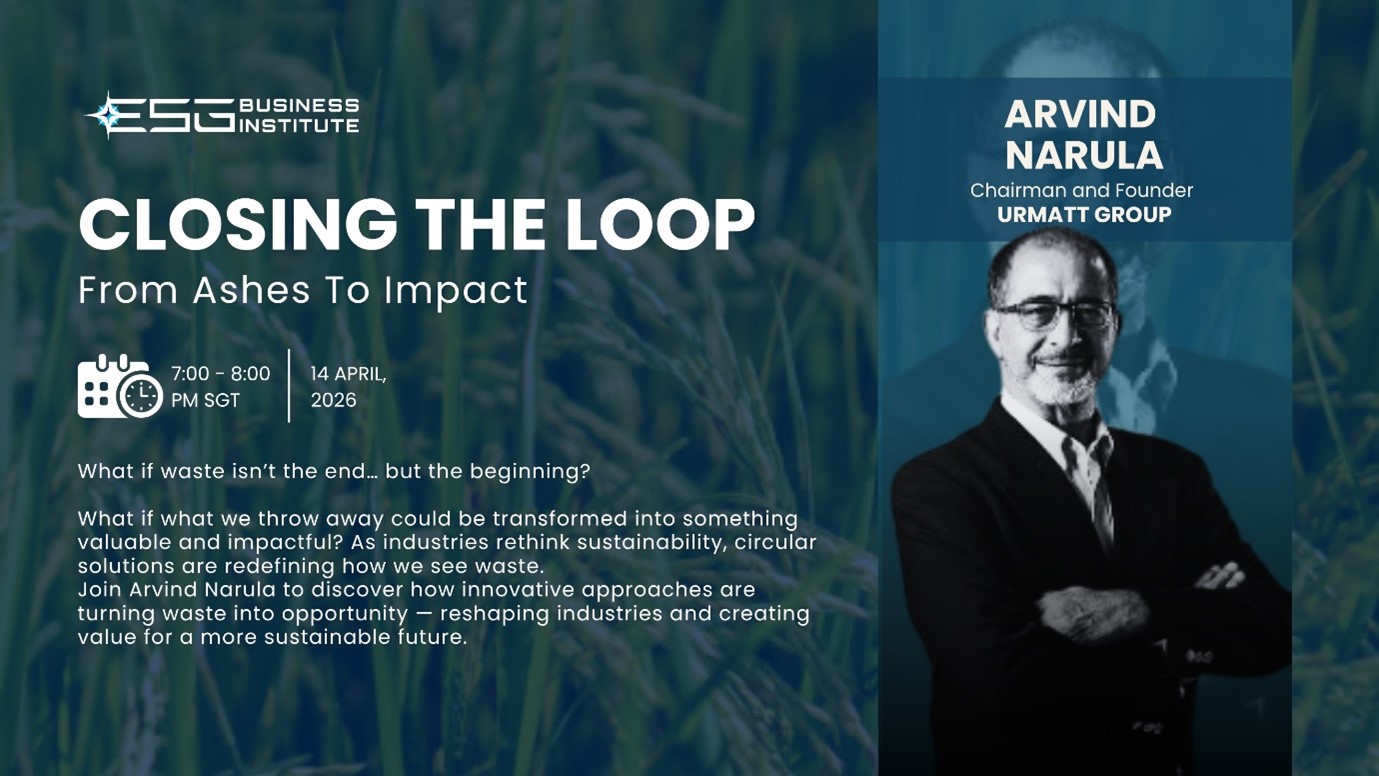
The Urgent Need to Rethink Waste
As environmental pressures intensify across
Southeast Asia, the limitations of the traditional “take, make, dispose” model
are becoming increasingly evident. In the webinar Closing the Loop: From
Ashes to Impact, Arvind Narula, Chairman and Founder of Urmatt Group,
highlighted how agricultural burning long seen as a cost-effective practice has
become a major environmental threat.
The scale is staggering. “Over 100 million
tons of straw are burned, which is between 100 and 180 million tons of CO₂
emitted every year,” Narula shared. This widespread burning contributes to
severe air pollution, affecting visibility, public health, and regional
ecosystems.
Turning a Problem into Opportunity
Rather than viewing farmers as the cause,
Narula approached them as key partners in the solution. By engaging directly
with farming communities, his team uncovered a simple but powerful insight: “If
you buy the straw, we won’t have to burn it.”
This led to the development of a circular
system where agricultural waste is no longer discarded but repurposed. Rice
straw is collected, processed, and transformed into valuable materials, effectively
closing the loop between agriculture and industry.
Building a Circular and Profitable Model
At the core of Urmatt Group’s approach is a
fully integrated circular model. Rice straw is converted into cellulose pulp,
which is then used to produce compostable packaging products. The process
generates multiple outputs, ensuring nothing goes to waste.
Narula explained, “we have two, three major
income streams: the pulp, the organic fertilizer, and compostable products, plus
carbon credits.” This diversified structure is critical to long-term viability.
As he emphasized, “If you don’t have a financially sustainable model, what you
are trying to achieve will collapse.”
Environmental Impact at Scale
The benefits of this model extend far
beyond waste reduction. By preventing open burning, it directly cuts carbon
emissions. By replacing wood-based pulp, it reduces deforestation. And by
producing organic fertilizers from by-products, it decreases reliance on
chemical inputs.
Additionally, the localized nature of the
operation minimizes transportation needs, further lowering the overall carbon
footprint. This demonstrates how circularity, when executed effectively, can
deliver both environmental and economic value.
Challenges and the Road Ahead
Despite its promise, scaling such a model
is not without challenges. Narula acknowledged that capital investment remains
a key barrier, especially in an industry that requires significant
infrastructure. “This is a generational project,” he noted, highlighting the
need for long-term commitment and support.
However, the potential remains vast. Even a
small share of the market can create meaningful impact. “Even if you looked at
1%… that would be humongous,” he said, pointing to the growing demand for
sustainable alternatives, particularly in packaging.
The Role of Consumer Demand
Beyond infrastructure and investment,
consumer behavior plays a decisive role in accelerating change. As awareness
around sustainability grows, so does the demand for responsible products. “It’s
always the end user, the consumer that drives demand,” Narula emphasized.
From choosing compostable packaging to
reducing plastic consumption, individual decisions collectively influence
market trends and encourage businesses to adopt more sustainable practices.
Urmatt Group’s Proven Success
Urmatt Group’s journey is a clear
demonstration that sustainability and profitability can go hand in hand. Over
the years, Narula has built one of the world’s largest organic jasmine rice
operations, supporting thousands of farming families while advancing zero-waste
practices.
Today, this success extends further through
its circular initiatives transforming agricultural waste into high-value
products, creating multiple revenue streams, and significantly reducing
environmental harm. From cutting millions of tons of emissions to empowering
rural communities, Urmatt Group stands as a powerful example of how innovative
thinking can turn “ashes” into lasting impact.
Want to dive deeper? Sign up as
an ESG Business Institute Member to view the full recording of this webinar and
gain access to more exclusive insights.