
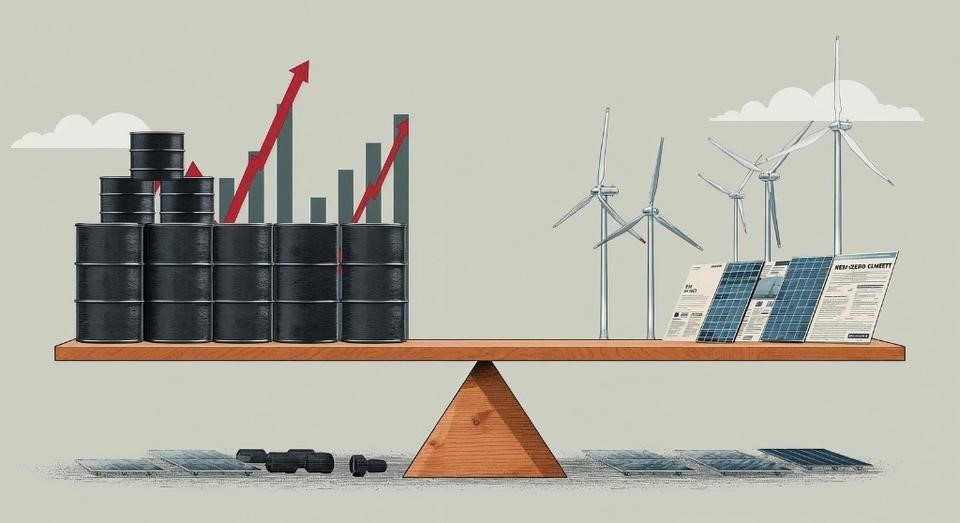
How the Middle East War Is Testing Global ESG Resilience and Energy Transition Commitments
The energy
transition has never been smooth but geopolitical shocks test it in ways that
market models rarely anticipate. The escalation of the Middle East conflict
following US-Israeli strikes on Iran on 28 February 2026 has sent shockwaves
through energy markets and raised urgent questions about the durability of ESG
commitments in an era of instability.
The Geopolitical Shock: What Happened
The immediate market response was sharp. Oil prices surged 13% as Iran moved to block the Strait of Hormuzv, a
chokepoint through which approximately 15 million barrels of oil pass daily.
Natural gas futures also spiked sharply in a single trading session.
The question for ESG investors and corporates is whether
this represents a temporary risk premium or the beginning of a structural shift
that could slow the energy transition.
The ESG Finance Reality Check
Moody's has forecast flat sustainable bond issuance for
2026 at around $900 billion, a
reflection of geopolitical headwinds balanced
against the ongoing need for climate mitigation finance.
Transition finance deals: green bonds,
sustainability-linked loans, and infrastructure investments are seen as most
vulnerable. In a "risk-off" environment, capital tends to prioritise
liquidity over long-term commitments, making it harder to attract funding for
projects with longer payback periods.
Regional Divergence: Who Is Most
Affected?
The impact is not
evenly distributed:
• Europe faces the dual pressure of
rising energy import costs and potential inflation. Experts have rejected calls
to suspend the EU Emissions Trading System (EU ETS), a market mechanism that
puts a price on carbon arguing that doing so would undermine the long-term
decarbonisation signal.
• Asia is experiencing supply chain
disruptions, including the blocking of shipments at key ports. The Middle East
is a critical trading partner for many Asian economies, and sustained conflict
would ripple through food, energy, and manufacturing supply chains.
• ASEAN markets are seeing supply chain
disruptions, though private market ESG deals are, for now, continuing to
proceed.
Short-term fossil fuel price spikes create a perverse
dynamic: they make renewables relatively more cost-competitive, yet the
uncertainty they generate can dampen the long-term capital commitments that the
transition requires.
Barclays has framed this through what it calls the "Transition Realism" thesis:
the argument that the energy transition "won't be smooth or linear."
Defence spending now competes directly with climate finance in fiscal budgets.
For governments already stretching public finances, hard choices lie ahead.
Does conflict ultimately accelerate or delay renewable
energy adoption? The honest answer is: it depends on how long it lasts, and how
governments respond.
What This Means for ESG Strategy
Two scenarios are in play:
• Base case: A relatively short-lived
disruption, with limited medium-term impact on ESG commitments and transition
investment. Markets absorb the shock and return to trend.
• Worst case: Sustained closure of the
Strait of Hormuz, prolonged high energy prices, and a broader inflationary
spike forcing companies to deprioritise long-term ESG capex in favour of
short-term cost management.
For corporates, the dilemma is real: maintain ESG
commitments when cost pressures are acute or use the disruption as cover to
slow progress. The companies that treat this as an opportunity particularly in
making the energy security case for renewables will be better positioned when
conditions stabilise.
The Long View: Nature and Climate Don't Pause for War
Perhaps the most important point is also the most easily
overlooked: the physical risks of climate change do not pause during
geopolitical crises. Extreme weather events, biodiversity loss, and the
compounding effects of inaction continue regardless of what happens in the
Strait of Hormuz.
The imperative for continued ESG action is not weakened by
volatility, if anything, the case for energy resilience, supply chain
diversification, and climate adaptation becomes stronger. The companies and investors that hold their course will be the ones
best placed to navigate whatever comes next.