
Technical Convergence and the Maturation of Climate Governance
ESG is entering a new phase — one defined less by ambition and more by precision. Over the past decade, sustainability commitments have multiplied rapidly. Net-zero pledges, climate transition plans, and science-based targets have become mainstream. Yetzing ESG as adoption expanded, so did scrutiny. Investors began questioning comparability. Regulators intensified oversight. Civil society raised concerns about greenwashing and inconsistent methodologies.
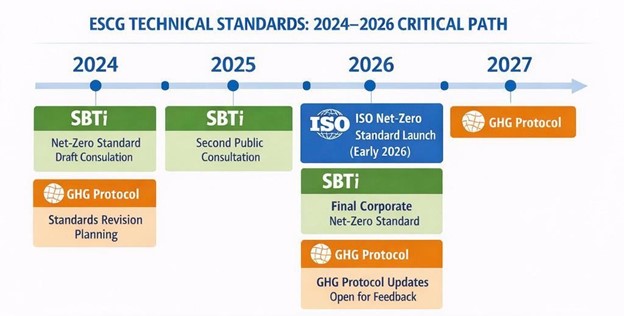
In response, the ESG ecosystem is undergoing technical consolidation. Major standardsetters are updating methodologies simultaneously, and new global benchmarks are emerging. At the center of this evolution is the forthcoming ISO Net-Zero Standard, expected in Q1 2026, a development reported by ESG Today that could significantly reshape how corporate net-zero claims are defined, verified, and trusted.
Rather than isolated updates, these changes represent something larger: the convergence of ESG technical frameworks into a more coherent, assurance-ready system.
The ISO Net-Zero Standard: A Global Reference Point
The International Organization for Standardization (ISO) is preparing to release a global net-zero framework designed to bring consistency to how organizations define and substantiate their climate commitments. According to reporting by ESG Today, the standard is currently under development and expected to be finalized in early 2026.
While full details are still under consultation, the draft is expected to:
- Define standardized criteria for credible net-zero claims
- Clarify emissions boundaries and treatment of residual emissions
- Provide guidance on the role and integrity of carbon credits
- Establish governance and verification expectations
The anticipated Q1 2026 release positions ISO as a unifying reference point across jurisdictions. ISO standards are frequently embedded into procurement requirements, regulatory frameworks, and certification systems potentially elevating the net-zero standard into a globally recognized benchmark.
Parallel Technical Shifts: A Broader ESG Recalibration
ISO development does not stand alone. Several major ESG frameworks are simultaneously undergoing substantial revision, signaling system-wide recalibration.
B Lab Global: From Points to Performance
B Lab Global’s updated recertification standards introduce mandatory performance requirements across key impact areas, shifting away from the previous points-based flexibility. The organization outlines the transition toward minimum performance thresholds in its standards of revision documentation available on the B Lab Global website.
The direction is clear: minimum requirements are replacing optional excellence. Companies must now demonstrate foundational impact performance rather than selectively optimizing scores.
GHG Protocol: Refining the Backbone of Carbon Accounting
The GHG Protocol, the most widely adopted greenhouse gas accounting standard is undergoing significant updates. Details on the current revision process and consultation timelines are available directly from the GHG Protocol’s official update page.
The revisions focus on:
- Enhanced Scope 3 guidance
- Clarifications around land use and removals
- Methodological refinements to improve consistency
Given that the GHG Protocol underpins emissions reporting for thousands of companies globally, these updates have material implications for reporting systems, disclosures, and third-party assurance processes.
Science Based Targets initiative (SBTi): Tightening Net-Zero Criteria
The Science Based Targets initiative (SBTi) is also revising its Corporate Net-Zero Standard. The draft consultation materials and revision updates are available via the SBTi website.
The proposed updates aim to:
- Strengthen Scope 3 accountability
- Clarify near-term versus long-term targets
- Refine criteria for carbon removals
- Tightening rules on the use of offsets
The scale of corporate adoption underscores SBTi’s influence. As documented by SBTi’s tracking data, thousands of companies worldwide have committed to or validated sciencebased targets.
A Comparative View: Complementary, Not Competitive
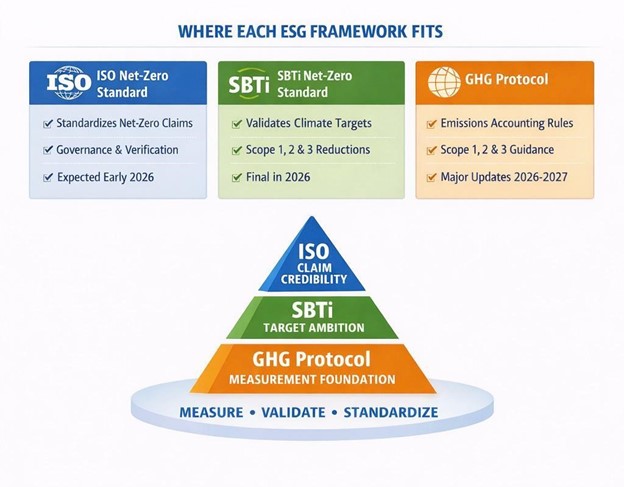
While ISO, SBTi, and the GHG Protocol serve distinct purposes, they increasingly function as complementary components of a broader governance architecture. Analysis of evolving ESG methodology timelines such as coverage by Trellis on ESG methodological updates highlights how these frameworks are converging in scope and ambition.
- The GHG Protocol defines how emissions are measured.
- The SBTi evaluates whether targets align with climate science.
- The ISO Net-Zero Standard is poised to standardize how net-zero claims are structured and verified.
Together, they form a layered system:
- Measure emissions accurately.
- Set science-aligned targets.
- Ensure net-zero claims meet standardized verification criteria.
This alignment reduces fragmentation and enhances comparability — two essential conditions for market trust.
Implications for Corporates: From Narrative to Infrastructure
As frameworks tighten and converge, corporates face a shift from voluntary positioning toward assurance-driven governance.
Assurance Readiness
Methodological refinement means stronger documentation requirements, more robust Scope 3 systems, and clearer transition planning. ESG reporting is increasingly intersecting with financial disclosure controls.
Investor Confidence
Institutional investors rely on technically credible frameworks to assess transition risk. Convergence across ISO, SBTi, and GHG Protocol strengthens comparability, improves risk modeling, and enhances confidence in climate claims.
A Signal of ESG Maturity
The near-simultaneous updates across ISO, SBTi, GHG Protocol, and B Lab are not isolated events. As outlined in coverage by Trellis and ESG Today, 2026 is shaping up to be a milestone year for ESG methodology evolution.
The shift is structural: ESG is moving from ambition-led commitments toward technically defensible infrastructure.
By 2026, net-zero claims will increasingly require alignment with harmonized, verifiable standards. Organizations that proactively prepare for this convergence will be better positioned to maintain credibility, secure investor trust, and navigate an increasingly regulated sustainability landscape.